
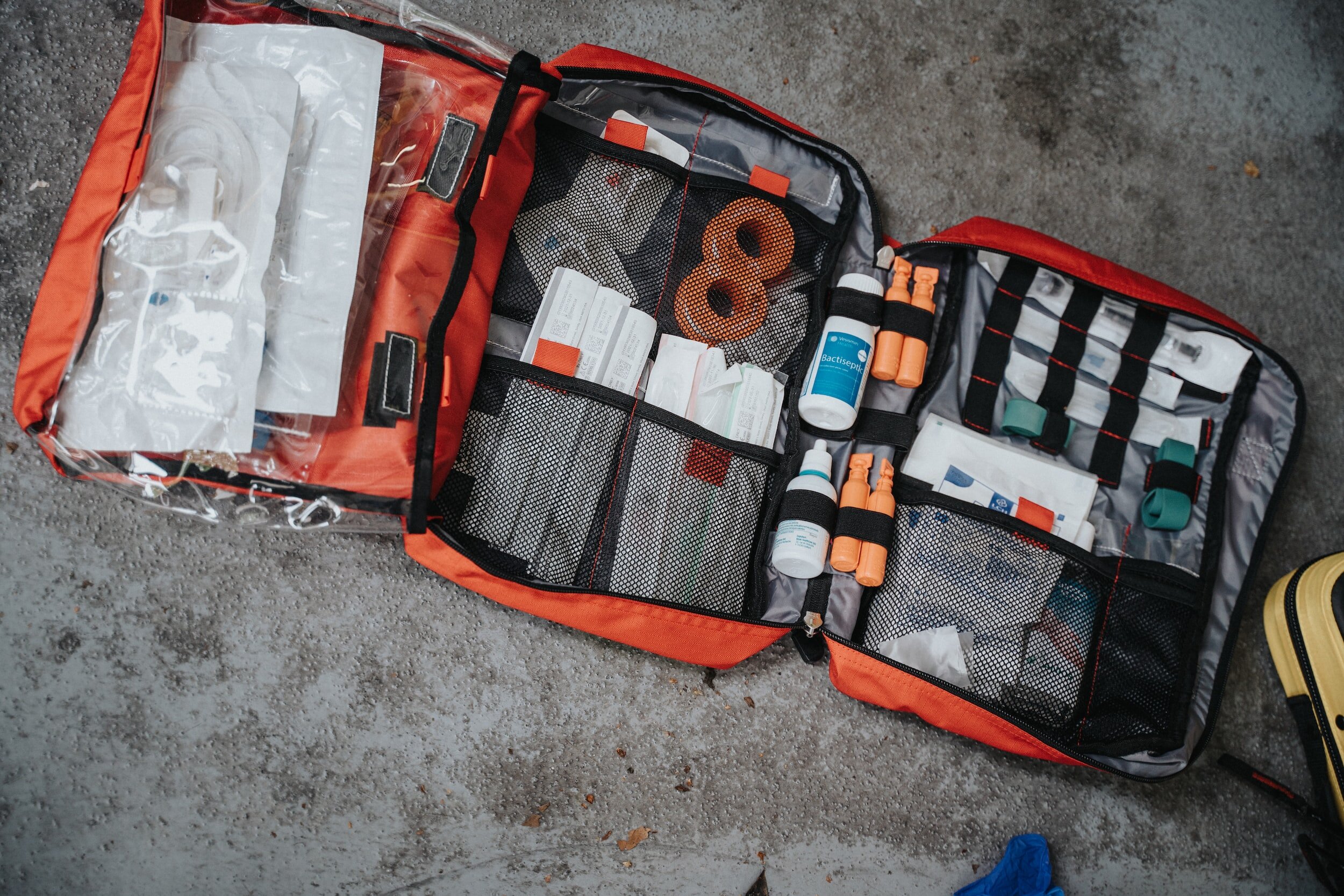
Part 5: I am not that clumsy, am I? Risk assessment at its most fundamental!
By Retta Witter, Senior Consultant, J. Geiger Consulting, Inc.
When I talked about how I wanted to lose weight in my backpack, under 20 lbs. before adding food and water, I looked at MVP or minimal viable product. The first aid kit is number six on my list of items. I have also talked about sharing the load among your hiking group but having backups for important items, like water filters, I think the first aid kit should have a backup. My first aid kit currently weighs 1.5 lbs. and has a lot of items I typically wouldn’t need on a hike. In order to assess the risk, I need to understand the risk, so I did some research.
When doing risk analysis and management there are two elements:
1) Risk Identification
2) Analysis
“You live in a grim universe. That’s risk management for you.” — Max Gladstone
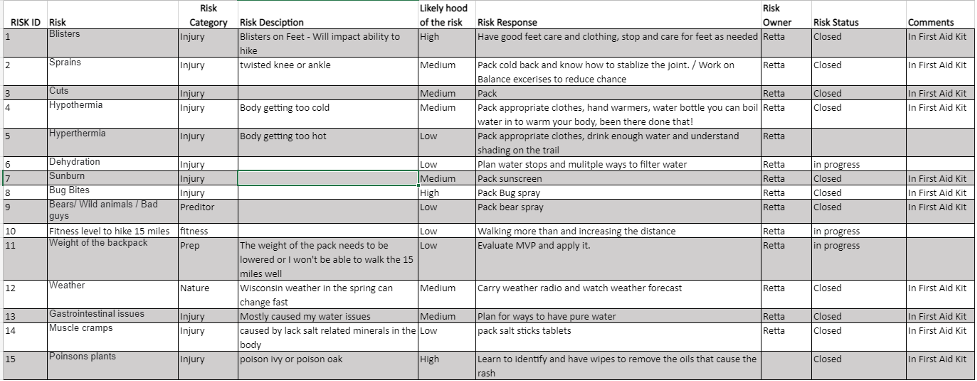
There are several ways you can document your risks; the key part is to keep track of them and their resolution. Some people use a RAID, Risk Action Issue Decision log and some people use a Risk Register. I find that PMs generally go with a RAID and BAs will use Risk Register. For my adventure I created a Risk Register.
The first element is risk identification.
In order to know what first aid items I would need, I need to know what the top injuries are that we are likely to experience, plus antacids. During our trip in October to Lake Eleven, I believe some of the shared trail mix gave me major heartburn and not a one of the three of us at antacids. It made for a memorable time like the wind chill of 12 however, I know if I want a positive adventure, not just a memory making one, I need to plan better!
The very first thing you MUST take into consideration is your health. What underlying health conditions do you have? I have no underlying health conditions so I am starting my risk assessment at a different place someone else might start theirs. My niece has diabetes so I know her, or her mom will have different considerations and different risk. Just like every person can have different risk so do companies or divisions.
After looking at many top 10 lists of risks, the most common ones I saw were (I cranked it up to 11 for good measure):
1) Blisters
2) Sprains
3) Cuts
4) Hyperthermia (think too hot, heat stroke, heat exhaustion)
5) Hypothermia (think camping in 12-degree weather)
6) Dehydration
7) Bug Bites
8) Sun burns.
9) Gastrointestinal issues – many sites believe it was related to improperly treated water.
10) Muscle Cramping
11) Poison plants (As a child I got poison ivy every summer and still couldn’t tell you what the plant looks like)
I also did some research at my local outdoor store to see what prepackaged items looked like. I must admit they had a first aid kit for EVERY type of trip. I want one I can change based on my hike plan.
I must admit I have been watching a lot of videos and doing research on what it’s like doing hike thrus and lessoned and all of them talk about feet care and blisters. The October hike I only had 1 blister, but I also only hiked about 10 miles total!
I am going to plan my first aid kit for:
1) 2 Nights
2) 16 miles of hiking
3) Wisconsin May weather
a. Cold or Hot, its Wisconsin
b. Buggy
4) Ear plugs for trail buddies who snore, we have all been there right? Are the ear plugs for them or me I will not say!
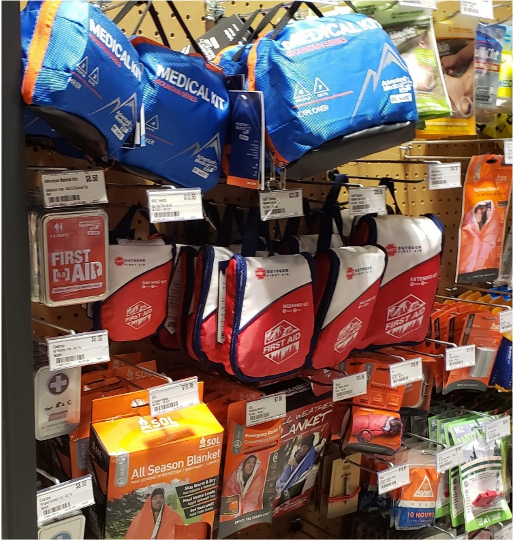
The prepackaged first aid kit has some useful items in it, but many aren’t what I need to match my risk register, so I raided my car, truck and houses and I was able to get what I think is needed.
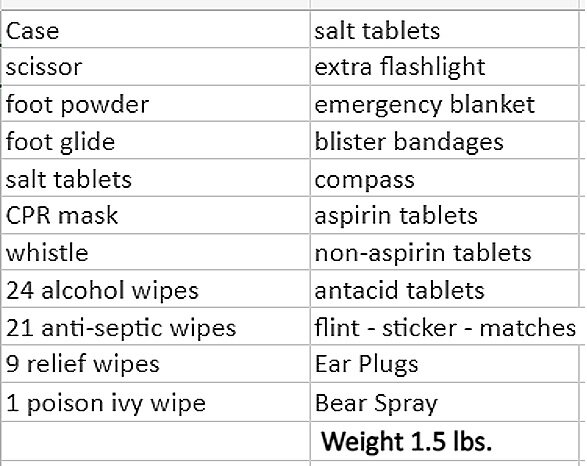
I didn’t save any weight by digging into my first aid kit and putting together my risk register, but I think I have a much more valuable and useful first aid kit for my plans.
One call out I want to have is protection against predators, that is why I carry Bear Spray. it is a pepper spray that shoots out about 30 feet to keep them away. One of the hiking groups I am apart of is woman hiking related and a common question people have is how do you protect yourself on while hiking on your own and there are several solutions. My answer is the bear spray.
Here is a copy of my risk register, it has more items then I discussed for my first aid kit because that wasn’t the only area that these is a risk I need to asses and address.
Do you see any item I missed addressing with my first aid kit or my risk register?
What is your biggest struggle with identifying or mitigating risks?