

Part Four – Strategy Analysis
By Retta Witter, Senior Consultant, J. Geiger Consulting, Inc.
Do you like road trips or planning your vacations? I do. I am currently planning a historical vacation to the east coast to visit old friends and celebrate my son’s graduation from high school next summer. How do I get to Manchester New Hampshire so a friend can pick us up, take us around Concord, then to Berlin, NH, and get back to Boston? What do we see in Boston? Do we do Philadelphia and Washington DC? If we take the train and use Ubers, we do not have to rent a car and deal with parking. How long should we be gone? Does Aunt Retta want to join us? She loved getting to know Rob and Monique in Vegas.
What does that have to do with business analysis skills? Well, it fits right into the next topic I wanted to discuss which is Strategy Analysis. Strategy Analysis is the first step of the BA value stream. How do you plan your trip? You discuss where you want to go but you also need to understand how to get there. Will it be a train, plane, or automobile? That is like the business world in the sense. In order to help you to understand where you are going, you need to understand where you are, what the need is, and why.
I worked for many years in the Electronic Data Interchange (EDI) space for a large global company. In the beginning, I worked on the projects and changes requested by our customers. My company was not driving the changes, our customers’ needs were. As I became more skilled and advanced in the work I was doing, I then got to understand how the company chose which customers to work with using EDI. Setting up EDI or any complex process can be expensive, so understanding the cost as well as the volume of time saved was a very interesting business decision. It revolved around the return on investment (ROI), but it also needed to be done strategically. When I understood it was not just the volume of orders or documents we could send via EDI, it was also which customers were we trying to increase our sales with. Setting those customers up with EDI had long term growth potential and was very important. When we were analyzing which customers to work with, we had to consider the tasks associated with Strategy Analysis. (1)
The Strategy Analysis knowledge area includes the following tasks:
• Analyze Current State: understands the business need and how it relates to the way the enterprise functions today. Sets a baseline and context for change.
• Define Future State: defines goals and objectives that will demonstrate that the business need has been satisfied and defines what parts of the enterprise need to change in order to meet those goals and objectives.
• Assess Risks: understands the uncertainties around the change, considers the effect those uncertainties may have on the ability to deliver value through a change and recommends actions to address risks where appropriate.
• Define Change Strategy: performs a gap analysis between current and future state, assesses options for achieving the future state, and recommends the highest value approach for reaching the future state including any transition states that may be required along the way.
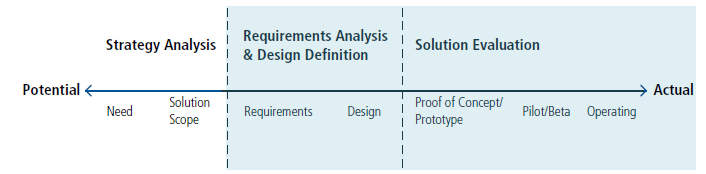
The new piece of info I would like to start with this week is the Business Analysis Value Spectrum. It will help you to understand how of all these intertwined pieces of information relate to each other. You can find the diagram in many places in the BABOK. Below is the chart.
You can see that Strategy Analysis is at the beginning of the process and the foundation for what comes after. Understanding the Need and the Solution Scope is important.
(2)
NOTE: The last two weeks in this blog series are Requirements Analysis & Design Definition (RADD) and Solution Evaluation so make sure to stay tuned!
SUMMARY
This chapter in BABOK v3 covers 5% to 15% of the certification test depending on which one you are looking to take. Strategy is the way to apply the capabilities of a company to help reach your goals and objectives. Strategy Analysis can be part of your department’s change plan or your company’s overall growth. The examples I am talking about revolve around EDI but can be applied to marketing, operations, or any part of the business.
PURPOSE
The purpose of Strategy Analysis is to help advance your company’s or department’s overall objectives while considering where the company/department is, where the company/department wants to go, and the risk of the making or not making change. This knowledge area works with all the standard stakeholders throughout the four tasks associated with the work. I think I like this knowledge area the best compared to the other areas because I love making people’s jobs better and easier. I believe a large portion of my ability to contribute to that is because of leadership’s desire to move the company/department in a strategic direction. This gets us in line with the big picture.
The task I relate to the most in this knowledge area is risk assessment. I love dreaming big and improving processes, however, I think an understanding of the impact of doing something is just as important as understanding the impact of not doing something. That is part of task 3, assessing risk. There are many techniques used in accessing risk and because I have a head for numbers, I am generally drawn into visualizing the information. Seeing the risk defined and documented in the risk impact scale helps stakeholders at all levels to understand what may happen.
An example from long ago that sticks with me to this day is the following story. It was early in my career and I worked for a company that did business with Sears. Sears was one of their top 5 customers. For Sears to improve their processes, they required their vendors to begin utilizing EDI within a specific time or lose their business. While implementing EDI was on my company’s improvement path, it was behind a few other initiatives until the risk of loss of business was understood (risk of not doing). The company had to reprioritize. In order to implement a new ERP system and the EDI transmissions for Sears, outside consultants were brought in to help supplement the staff. I took a few months of testing to get all the data mapped successfully. Unfortunately in 2018 Sears filed for bankruptcy. While that is an extreme risk example, I am sure you know of many companies that were the top of their field but didn’t understand or address the risk or implement strategy changes in their marketplace and are no longer in business.
What examples have you seen regarding good strategy analysis or ones that could use some improvement? Please comment below.
Hope you stop by next week; I will be discussing the knowledge area RADD.
1. (International Institute of Business Analysis, 2015, pp. 99-132)
2. (International Institute of Business Analysis, 2015, p. 100; International Institute of Business Analysis, 2015)
Bibliography
International Institute of Business Analysis. (2015). BABOK A GUIDE TO THE BUSINESS ANALYSIS BODY OF KNOWLEDGE (Vol. V3). Toronto, Ontario, Canada.: IIBA.