

Part Six – Solution Evaluation
By Retta Witter, Senior Consultant, J. Geiger Consulting, Inc.
When I was graduating from college, I wanted to make sure I had a reliable vehicle, so I bought a brand new 4-cylinder car. It met my requirements of being reliable and it had great gas mileage, but no one would call it performant. At the very least, I never got a speeding ticket with it. When I traded that car in 12 years later, I got one with turbo which had a lot more get-up-and-go. For the record, I still have never gotten a speeding ticket…but I could have.
View fullsize

What do my cars have to do with BA work and Solution Evaluation? Performance. In Solution Evaluation, we address solution performance and fit.
View fullsize
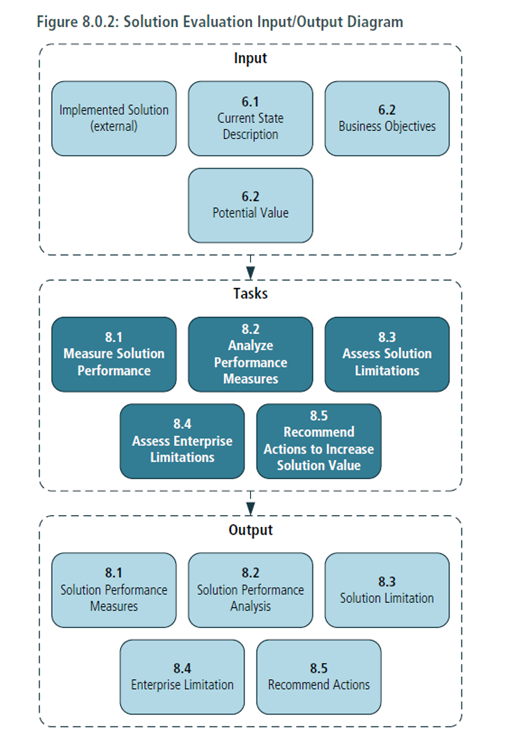
There are 5 tasks associated with Solution Evaluation and 2 of them discuss performance. As you can see in the Solution Evaluation input/output diagram, the inputs for Solution Evaluation come from Strategy Analysis, (Part Four – Business Analysis Body of Knowledge Blog Series) and are used by the 5 tasks. The key techniques used in this knowledge area are Risk Analysis and Management. To understand if the recommended solution is going to work well, the tasks of Assess Solution Limitation as well as Assess Enterprise Limitation are key and both require understanding the risk assessment. As you can see in the diagram, Strategy Analysis and Solution Evaluation are very closely linked. To have the best solution, based on current knowledge, you need to fully understand your strategy.
(International Institute of Business Analysis, 2015, pp. 166; International Institute of Business Analysis, 2015)
Summary:
This chapter in BABOK v3 cover 1% to 14% of the certification test depending on which one you are looking to take. This knowledge area is not on the test as much as the other areas we have discussed; however, if you are working on a system for the long-term, Solution Evaluation is very important. This knowledge area is really what the IIBA BABOK is all about. What is the value of the solution and the value add for the company and its shareholders?
Purpose:
The purpose of Solution Evaluation is to take a hard look at solution options to determine viability and alignment to requirements. This knowledge area relies heavily on understanding the system and related data and comprises some of the most diverse techniques used including benchmarking, data mining, documentation analysis and modeling. (International Institute of Business Analysis, 2015, pp. 163-186; International Institute of Business Analysis, 2015)
On a personal note, the task that most resonates with me is Measure Solution Performance. When I first got out of college, I spent a lot of time in the technical arena on things like trying to make newly minted ERP reporting/BI more performant. I focused on the speed of data processing behind the scenes. At the time, there seemed to be nothing more challenging than trying to get business users, who are already comfortable with the software they are using, to buy into a new less performant solution. This was a recipe for considerable resistance.
I learned quickly that data growth and subsequent reporting performance degradation are commensurate with the length of time that a system (e.g., an ERP system) has been up and running. The larger the amount of data, the more important it becomes to assess things like efficient queries, explain plans and other areas bearing the most impact to reporting performance. This is an ongoing process and relates well with the task of Increasing Solution Value.
For the task Measure Solution Performance, the key technique for me is: Metrics and Key Performance Indicators, KPIs. Understanding what expected performance looks like aids in determining if the solution is performant enough, or if “tweaks” need to be made to better meet businesses expectations. Having worked on performance tuning several different times over the past 20 years, I find it is important to get quantitative measures (i.e., “The system is slow” without having actual numbers makes it hard to know what “slow” really means). Establishing a baseline along with measurements over time is critical to determining whether the solution “as-built” is hitting expectations or missing the mark.
What area do you relate to the most? Please let me know if you’ve liked reading my blogs or if you have ideas or feedback you’d like to share. I have certainly enjoyed spending time with you. I will be starting a new series covering the IIBA 6 underlying Competencies on November 2nd. This series will end with a round table discussion. Stay tuned for more info!
Bibliography
International Institute of Business Analysis. (2015). BABOK A GUIDE TO THE BUSINESS ANALYSIS BODY OF KNOWLEDGE (Vol. V3). Toronto, Ontario, Canada.: IIBA.