

Part Five – Requirements Analysis and Design Definition
By Retta Witter, Senior Consultant, J. Geiger Consulting, Inc.
As you might have come to realize my husband and I have a 17-year-old son. He is a senior in high school, and we have been talking to him about going to college. We have been talking about where he would like to attend, what majors he might be interested in, just like many parents do at this point in their child’s life. With the pandemic hitting during his junior year and uncertainty to what his senior year might look like, just like you have probably done we as well had to adjust. My husband and I were both working from home for a while, as was our son.

We realized that he needed a better space to work more effectively from. Being the IT people, we are, yes, my husband is in IT too (however, he is in the hardware side of the house), we started analyzing our needs as a family to better plan. This past summer, while our son was away volunteering at a camp, we decided that this window of time would be the opportune time to redo his room, as we had done this many of times over the years as he grew.
His room, for us, is an iterative process, much like the work a BA will be doing.
-
You realize a need: We don’t have good workspace for long term working from home for 3 people.
-
You think about your long-term goals: Maybe he may be living at home while going to college?
-
What changes will get us to our desired outcome: We have a new reality and we needed to readdress our requirements, define solutions options and analyze the options and determine a solution.

A few years after we had our son, I went back to work full time. I started at a company while simultaneously/also beginning my MBA program, the CFO had an all-hands-in meeting to talk about the strategy shift our leadership had chosen to undertake. Having spent most of my career implementing ERP systems, mostly as a consultant, I had not had the opportunity to be a part of knowing the company’s larger strategy and I found it fascinating. The company was choosing to strategically partner with clients where they had the most growth potential, while also cutting ties with customers that didn’t have a desired ROI. Mind you, I have a bachelor’s degree in business administration, and during my undergrad studies we never really had talked too much about choosing to cut ties with customers. All I knew at this point was that in business that sales = growth potential which would then increase shareholder value.
Once the new strategy was announced, many departments had to start looking at the new strategy (Part Four – Business Analysis Body of Knowledge Blog Series) and how it impacted their departments requirements. This entailed doing some of the elicitation and validation of the requirements which in turn then feeds into today’s blog. They needed to validate the new requirements, define a solution options and then analyze those solutions. Was some of the solutions to implement EDI, like we talked about last week, or was it more important to work with the customer in order to increase the size of their orders so that the cost of each run was reduced due to economy of scales? It also included working on process improvements, so that we got the work we did for the customer was as cost efficient as possible.
How does that relate to BA work and RADD? I work in the IT space, but I know that not all business analysis work resides here in the IT world. There are also lean initiatives that also use business analysis skills. Another fun fact about me is that I grew up in a rural farming community, most people who didn’t work on the family farm worked in manufacturing and for the most part that hasn’t changed very much in the past 25 years since I left high school. Henry Ford has been a huge leader of lean manufacturing, however, in the US the real surge of lean manufacturing started in the 1980s. In lean manufacturing there is a lot of RADD happening.
The Requirements Analysis and Design Definition knowledge area includes the following tasks:
-
Specify and Model Requirements: describes a set of requirements or designs in detail using analytical techniques.
-
Verify Requirements: ensures that a set of requirements or designs has been developed in enough detail to be usable by a particular stakeholder, is internally consistent, and is of high quality.
-
Validate Requirements: ensures that a set of requirements or designs delivers business value and supports the organization’s goals and objectives.
-
Define Requirements Architecture: structures all requirements and designs so that they support the overall business purpose for a change and that they work effectively as a cohesive whole
-
Define Solution Options: identifies, explores and describes different possible ways of meeting the need.
-
Analyze Potential Value and Recommend Solution: assesses the business value associated with a potential solution and compares different options, including trade-offs, to identify and recommend the solution option that delivers the greatest overall value.
-
(International Institute of Business Analysis, 2015, pp. 133-162; International Institute of Business Analysis, 2015)
Summary:
This chapter in BABOK v3 covers 24% to 32% of the certification test depending on which one you are looking to take. This knowledge area is the most tested on by far but is also an extremely important part of business analysis work.
Purpose:
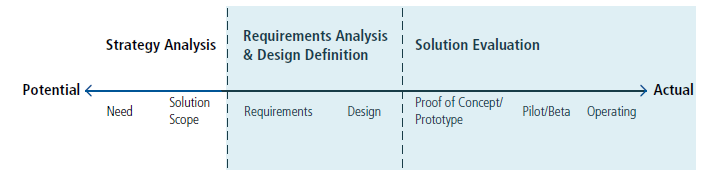
The Requirements Analysis and Design Definition knowledge area describes the tasks that business analysts perform to structure and organize requirements. This knowledge area covers the incremental and iterative activities ranging from the initial concept and exploration of the need through the transformation of those needs into a recommended solution. If you remember last week’s blog, I brought in the Business Analysis Value Spectrum and RADD was the middle section bridging the area of strategy/need to the Solution.
2. (International Institute of Business Analysis, 2015, pp. 133-162; International Institute of Business Analysis, 2015)
-
(International Institute of Business Analysis, 2015, p. 134; International Institute of Business Analysis, 2015)
One of the topics I am hearing a lot about these days is, “How do we keep people working as safe as possible?” To fulfill that requirement, many employers requested that employees work from home. So how do you now design a collaborative remote workspace? Business processes and IT solutions will work hand in hand to allow for this to happen. In the past 7 months there have been many iterations of a requirements defined and solution evaluated. Many of the requirements for the ability to work remote has changes to some extent, the volume of users has increased, and design of the solution then needs to be addressed.
I know many people who are learning new technologies like Zoom, or Teams to keep the work continuing, while adapting to the new norm. Earlier this week it was announced that REI, an outdoor retailer (who carries some of my favorite camping gear), was set to open a new headquarters this summer in Washington but because of the pandemic they did not. Now, because the remote working is going so well for them, they chose to sell the headquarters complex to Facebook (Soper, 2020) without ever moving in. That is a basic example is a great example of understanding how things can change a company’s strategy and the need to modify the requirements, design and therefore the solution.
A lot of what I am talking about today really fits into the task define solution options as well as analyze potential value and recommend solutions. I find them to be the most interesting simply because as Norman Vincent Peale once said “Shoot for the moon. If you miss it, you will still land among the stars.” What examples have you seen lately that talk about Business Analysis Value Spectrum?
Stay tuned for next week’s Solution Evaluation blog.
Bibliography
International Institute of Business Analysis. (2015). BABOK A GUIDE TO THE BUSINESS ANALYSIS BODY OF KNOWLEDGE (Vol. V3). Toronto, Ontario, Canada.: IIBA.
Soper, T., 2020. Facebook Buys REI’S New HQ For $367M, Expanding Seattle-Area Footprint Beyond 3M Square Feet. [online] GeekWire. Available at: <https://www.geekwire.com/2020/facebook-buys-reis-new-hq-367m-expanding-seattle-area-footprint-3m-square-feet/> [Accessed 16 September 2020].